At war with Iran. The dominoes of pressure
The US and Israel have began a war they do not seem to have properly planned, risking to destabilise the region without a guarantee of success. Initially, the stated goal was to "decapitate the regime," giving Iranians a chance to take over the government, but the chaotic messaging suggests the why is murky.
 Smoke billowing from the US 5th fleet base, Bahrain, 28.02.26
The remarks by the secretary of state Marco Rubio on Israel's role - that it essentially forced the US' hand into entering the conflict - beg the question who was wagging whom: the dog the tail, or the tail the dog? Leaders of both nations have their reasons to make war: Netanyahu seeks to return to his image of Mr. Security, which has been severely damaged by the failures surrounding October 7th, 2023. Additionally, he seems to view military conflicts as a get out of jail card - in his rhetoric, the charges of corruption and endangering democracy have to wait until a war ends.
Trump, similarly, may be using the war to turn the attention away from trouble at home. Noone at the moment seems to remember his ties to a known peadophile Jeffrey Epstein, or even less the fact ICE is increasingly similar to a nazi militia. That he would start a deadly armed conflict to cover up his questionable friendships or human rights abuses is really worrying.
People across Iran both celebrated and mourned the killing of Ayatollah Ali Khamenei. However, there has been no evidence to suggest that Iranians are rising against their government - it may have something to do with their hiding from American and Israeli bombs. Militaries of both nations have targeted civilian infrastructure, including a desalinisation plant, and a school where 150 people died. Certainly not a way to win favour with the public. There isn't any way to gauge public sentiments in Iran at the moment, but there's also awareness across the region as to what happens as a result of foreign military interventions.
Better the devil you know
The deposing of Saddam Hussain in 2003 was also met with euphoria from Iraqis. However, the breath of fresh air of freedom quickly gave way to the fug of civil war. In dissolving the Iraqi army and cleansing the public services from members of the Baath party, the Americans created conditions for the proliferation of increasingly extermist resistance groups, some of which later formed the so called Islamic State.
Libya after the killing of Muammar al-Ghaddafi has effectively became a failed state, and it has not unified after fifteen years of internal strife, in that a civil war. The state is a hotbed of human rights abuses and violence. Syria a year after the fall of Bashar al-Assad remains unstable, with attacks on minorities - including a recent open conflict with the Kurdish authorities - and the Islamic State rearing its ugly head, calling the new president - a former jihadist - an apostate.
The question those interventions leave us with is whether the ongoing Western aggression against Iran is worth the chaos it risks breeding. It's already destabilising the region - the price of oil has gone up, which will beget higher inflation worldwide; trade and travel is limited with the closure of regional airspace and the strait of Hormuz. It puts a major strain on public wellbeing, as well local and global economies. The Arab Gulf states are in the process of diversifying their economies, aiming to become tech, transport and tourism hubs of the region. Limitations on trade, travelling, and attacks on infrastracture like the Amazon servers will put a dent in those plans - business does not like war.
The removal of the regime from power risks creating a power vacuum which may lead to internal conflict and chaos akin to that of Iraq and Libya. But Iran is the region's largest country - the effects on the region or the world could be exponentially larger than with a medium-sized country like Iraq. Israel is reportedly open to the idea despite the risks: the Jewish state is seeking to become the regional hegemon, and would rid itself of a major regional competitor if the Ayatollahs were no more. But then, what with the civilians? Iranians, and Arabs, and others deserve a stable, safe, and democratic home. Israeli and American actions in the region are not constructive to that.
There's little to suggest that the Islamic regime will be gone soon. The system has been set up in a way that favours decentralisation in precisely the conditions such as these. With the Ayatollah and high ranking commanders gone, the military forces are able and expected to keep on fighting autonomically. That was illustrated with the remarks by President Pezeshkian of Iran. While he made his apologies to Iran's Gulf neighbours for attacking them, Iranian missiles and drones have kept on raining on their heads. One crashed into Dubai International Airport, and several damaged civilian targets in Kuwait and Bahrain, including a desalinisation plant in the latter.
With the death of a Supreme Leader, the power over the state goes onto the president, the judiciary and religious leaders, as well as the Revolutionary Guard and the military. This allows for the continuation of power in the hands of the regime even if high ranking officials are expired. All of them have a succession of deputies to take their place.
Additionally, Iran is lacking an organised opposition movement. One argument often brought up regarding the future of a regime is the loyalty of its security forces: if they're pouring over to the protestors, the regime's days are numbered. But whom should the Revolutionary Guards join? Or the members of the basij? The opposition in Iran is a mosaic of ideological and ethnic forces following different goals. There is no unified front, which could step in the absence of formal authorities.
Tense calm
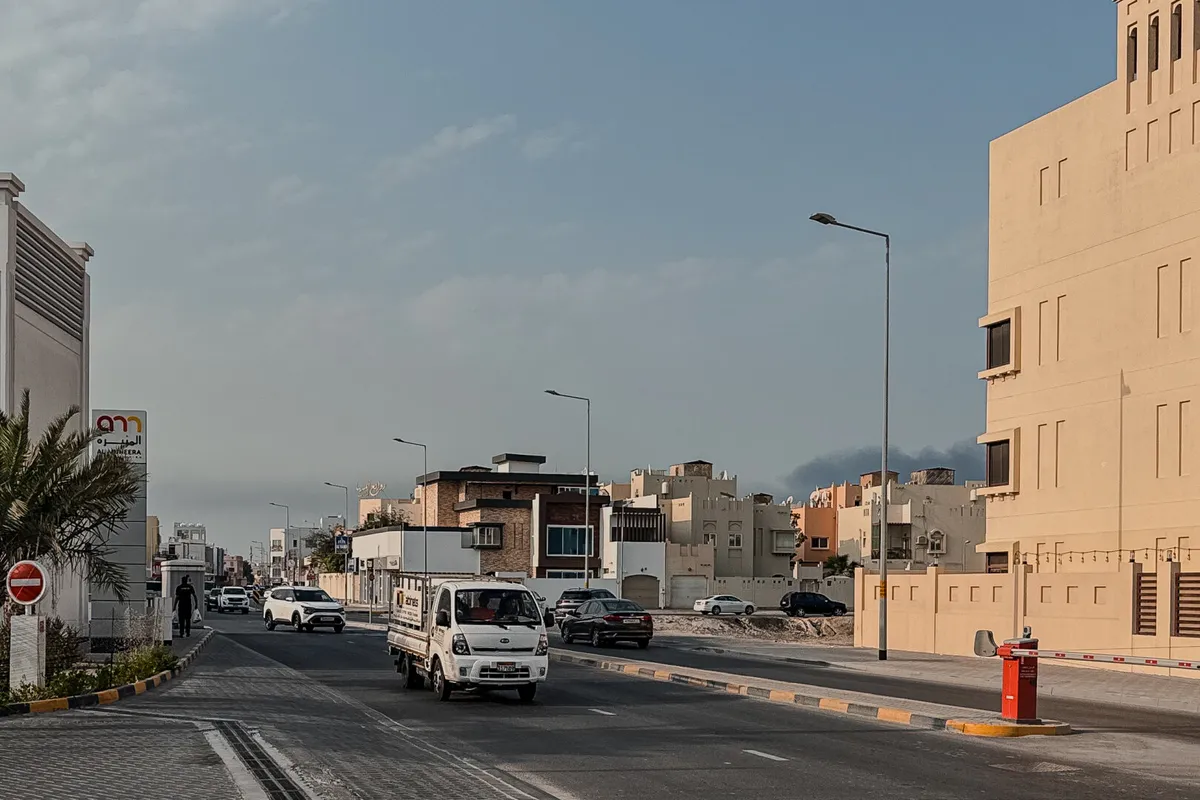
Public sentiments on the Arab side of the Gulf may well be described as a tense calm. Bahrain arrested a number of people who publicly praised Iran's attacks on it, as well as some who published visuals of the attacks. Public institutions, banks, schools and universities, and many companies have gone on to work remotely. The sounds of sirens, hits and air defences at work are a daily occurrence, sometimes several times a day. The first day marked higher traffic on petrol stations and in shops, but have things calmed in later days. People wait to see further developments, although a number of foreign residents have left the country through Saudi Arabia.
After a hit on the Crown Plaza hotel, the US embassy in Bahrain advised Americans to avoid hotels, as potential targets. In the light of (so far unverified) reports that American citizens may themselves be targeted, the embassy also published an advisory for them to stay away from tall buildings. The district where the American 5th fleet is located has been evacuated, and guests in many hotels have been asked to come down to the lobby.
Manama, Bahrain, 08.03.26
The dominoes of pressure
A number of people have died across the Arab Gulf states, and more have been wounded. Iran has attacked both American military infrastructure, such as the US 5th fleet base in Bahrain, and civilian infrastructure, including hotels, skyscrapers, petroleum infrastructure, and others. There appears to be an Iranian policy of pressure on the Arab Gulf states to pressure Americans to stop their attacks on Iran. Indeed, Gulf states are reported to consider reviewing of their investments in the US, which Washington has noticed. They've already looked at whether the force majeure clause could be invoked in current contracts. The war they've been dragged into by the Americans and the Israelis has put a major strain on their budgets, and limiting foreign investment might be one way of easing that pressure.
Earlier conflicts, such as the exchange of salvoes with Israel in April 2025, were much more choreographed, when Iran tried to avoid escalating "too much." Tehran gave more weight to saving face by showing that it does not ignore being attacked. Arab leaders indeed worked on Trump not to avenge Iranian protestors right after the bloody protests last December and January, and it seemed to have worked at the time. Now, however, the regime is fighting a war of survival, and its answer is much more escalatory. Donald Trump said he expected the conflict to last 4-5 weeks, but with both sides entrenched in their positions, there is a potential for the war to go on longer. Trump said he wants Iran's complete capitulation, which Pezeshkian called "a dream that our enemies will take to their grave." In the end, Russia also expected its invasion of Ukraine to be short and sweet, but we've just entered the 5th year of their 3-day special military operation.